Interpreting results
After a round closes, the Results view becomes your main decision-making surface. It brings together statistical output, flags, and system recommendations so you can determine which items have reached consensus, which need revision or another round of rating, and whether the study is ready to conclude.
Per-item results
The Results view lists every item in the round as a card carrying its statistics, classification, and any flags. The round view offers the same information as a compact table.
| Column | What it shows | How to use it |
|---|---|---|
| Item text | Current wording (with revision indicator if changed) | Identify which version of the item was rated |
| Median (IQR) | Central tendency and spread | Lower IQR indicates greater agreement |
| % agreement | Share of ratings at or above the agree-zone floor, shown as "N% ≥ K" | Compare against the study's agreement threshold |
| Distribution | Rating counts across the scale's zones | Reveals whether agreement is broad or clustered |
| Disposition | Decision badge — Included, Re-rate, Excluded, or Awaiting — alongside the computed outcome (consensus_in, consensus_out, no_consensus, consensus_with_subgroup_divergence, or insufficient_data) | Starting point for your decision |
Two flags appear inline on the item itself:
- Bimodality: at least the configured share of ratings sits in each of the agree and disagree zones, with few in the middle — strong opinions at both ends
- Unable to rate: a large share of abstentions, suggesting the item may not be evaluable by the full panel
Related signals appear elsewhere rather than as item flags: instability since the previous round is summarized in the stability panel and top-movers table; too few valid ratings produces the insufficient_data outcome instead of a consensus class; and stakeholder divergence surfaces as the consensus_with_subgroup_divergence outcome, carried into Plan next round and the final report.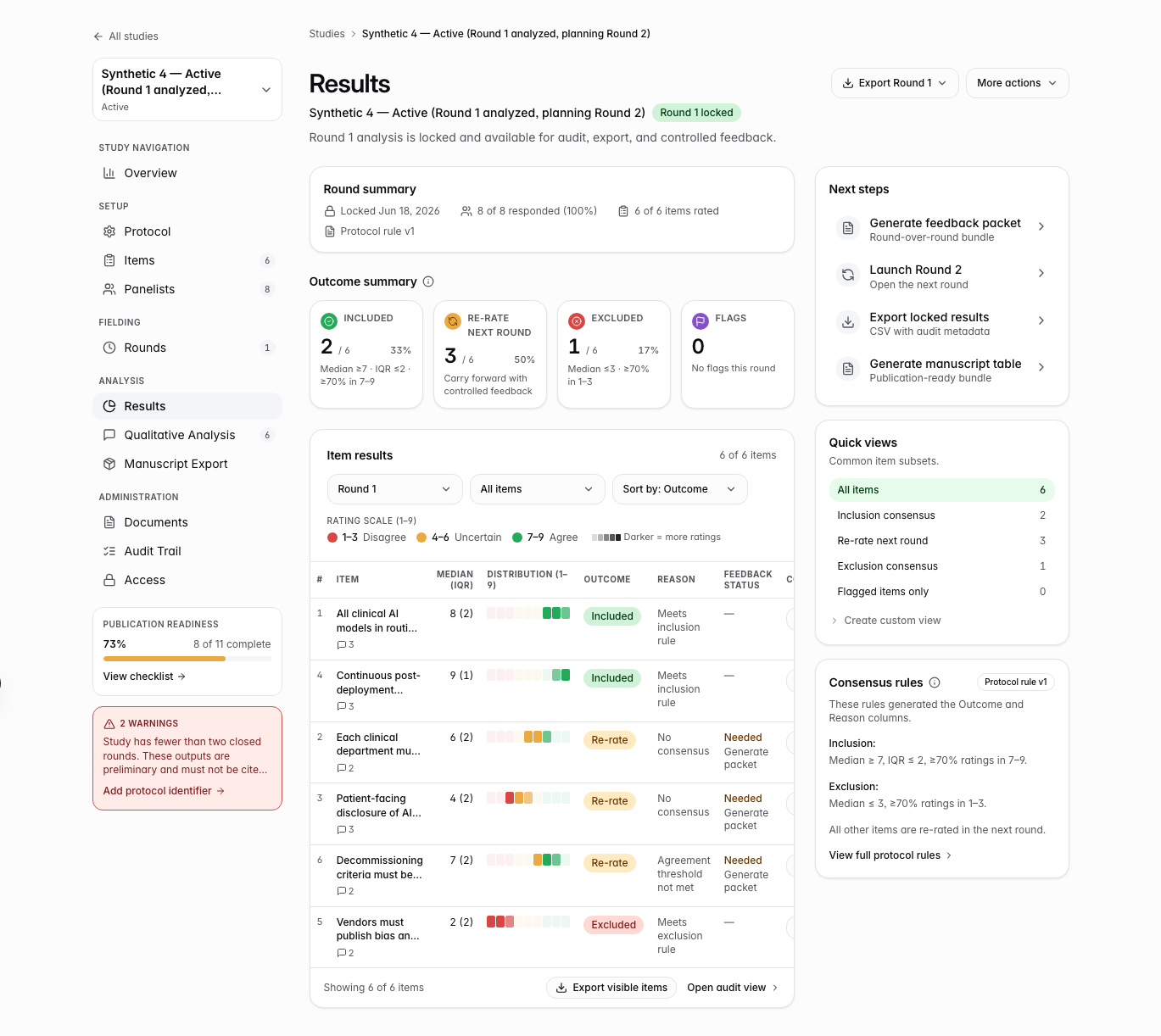
Reading a single item
Example 1 — Clear consensus (retain)
| Field | Value | Interpretation |
|---|---|---|
| Median | 4.5 | Strong central agreement |
| IQR | 0.5 | Very low dispersion |
| % Agree (4–5) | 93% | Overwhelming support in the agree zone |
| Zone | Agree | Meets all consensus criteria |
| Disposition | retain | Ready to include in final set |
Example 2 — False consensus risk
| Field | Value | Interpretation |
|---|---|---|
| Median | 4 | Appears acceptable at first glance |
| IQR | 2 | High dispersion |
| Bimodal flag | Yes | Significant opinions at both ends |
| Zone | Indeterminate | Correctly held back despite median |
In this case, the median looks acceptable, but high spread and bimodality correctly prevent a consensus classification.
Disposition decisions
Use the system's recommended disposition as a starting point, then apply your judgment:
| Disposition | When to use | Typical outcome |
|---|---|---|
| retain | Clear consensus in the Agree zone | Item joins the final set |
| drop | Clear consensus in the Disagree zone or team decides to exclude | Item removed from study |
| revise | Indeterminate + wording issues identified | Item reworded and re-rated in next round |
| re_rate | Indeterminate but wording is acceptable | Item carried forward unchanged for another round |
Overrides
You may override the system's recommended disposition before you confirm it. Overrides require a rationale of at least 20 characters and are recorded in the audit log with the previous and new decision. Once a disposition is confirmed it is frozen: further corrections go through a derived re-analysis rather than an edit, so the contemporaneous result stays intact.
Common scenarios for overrides include:
- Borderline IQR: Retaining an item with a note in the discussion section
- Clinical or safety imperative: Revising wording even when the panel reached agreement
- Panel fatigue: Dropping unresolved items after the maximum number of rounds
Overrides should be used thoughtfully and transparently.
Derived re-analysis
Use derived re-analysis when the frozen round result is still correct as history, but a correction scenario requires a recomputed view:
| Scenario | Example |
|---|---|
| Withdrawal | A panelist withdraws after Round 2 closes; you need to show which items would change if that panelist were excluded |
| Data correction | A panelist was enrolled in the wrong stratum or a misclassification is discovered |
How it works:
- Choose a closed or analyzed round and the panelists to exclude.
- Delphi Studio recomputes per-item statistics and classification against the same frozen consensus rules.
- You receive a per-item diff (original status → new status) and a changed-item count.
- The original dispositions and hash-chained audit log are never rewritten.
- Optionally designate the re-analysis as the authoritative reference for the manuscript while keeping the original for the record.
Re-analyses appear in the Results view's re-analysis panel and travel in the trace bundle as analysis_versions.json, so reviewers can see both the contemporaneous result and the corrected view.
Sensitivity analysis (post hoc)
Threshold sensitivity compares how dispositions shift under alternative rules (for example 80% vs 75% agreement). Always present these as post hoc robustness checks, not as the pre-specified analysis path.
Stopping recommendation panel
After analysis completes, review the stopping recommendation. Common signals include:
| Signal | Suggested action |
|---|---|
| All (or nearly all) items classified as retain or drop | Stop the study and move to reporting |
| Small number of stable indeterminate items | Adjudicate the remaining items or document as a limitation |
| Majority of items still moving | Plan another round |
| Maximum number of rounds reached | Conclude with a clear table of unresolved items |
The recommendation is advisory. You should consider it alongside response rates, stability trends, and the overall goals of the study.
Round-over-round movement
The trajectory view helps you assess whether the panel is converging:
| Pattern | Interpretation | Implication |
|---|---|---|
| Median drifting toward the agree zone | Convergence occurring | Positive sign — consider continuing |
| IQR shrinking | Opinions becoming more consolidated | Good progress toward stability |
| Frequent zone flips (Agree ↔ Indeterminate) | Unstable opinions | May need more rounds or item revision |
| Little change across two rounds | Stability achieved | Candidate for stopping |
This view is particularly useful when deciding whether another round is likely to produce meaningful movement.
Subgroup divergence
When different subgroups (e.g., by specialty or experience level) show meaningfully different medians, you have several options:
- Note the divergence in the results.
- Decide on an approach: report overall consensus with a caveat, aim for stratified consensus, or revise the item.
- Document your decision and rationale in the manuscript discussion.
| Subgroup A median | Subgroup B median | Recommended action |
|---|---|---|
| 4.5 | 4.3 | Report overall consensus |
| 4.5 | 2.8 | Flag divergence; consider revision or stratified reporting |
Publication readiness
The study overview includes a publication readiness checklist that pulls information from across the platform:
| Criterion | Source |
|---|---|
| Protocol and consensus rules documented | Launch snapshot and methodology export |
| Panel size and response rates reported | Panel and round statistics |
| Item-level outcomes available | Results view |
| Qualitative synthesis reviewed | Qualitative workspace |
| Methods and results text generated | Manuscript drafting tool |
| Tables and figures exportable | Report and export surfaces |
Completing this checklist helps ensure you have the necessary documentation before finalizing the study.
From results to next round
A typical workflow after reviewing results is:
- Review the heatmap and flags for items needing attention.
- Revise item wording in the item bank where needed.
- Run qualitative analysis if open comments informed revisions.
- Use Plan next round and document your inclusion rationale.
- Lock feedback packets (for Round 2+).
- Open the next round.
This sequence keeps the process structured and auditable.
Next steps
- Consensus analytics — statistics, cross-stakeholder rules, re-analysis mechanics
- Running rounds — plan and open the next round
- Multi-round worked example — end-to-end scenario
- Reporting & exports — publish findings