Panel management
The Panel area in Delphi Studio is the central place to recruit experts, manage participation, track consent, and monitor engagement throughout the study. It is designed to protect panelist privacy while giving researchers the tools they need to run a rigorous and well-documented Delphi process.
Recruitment workflow
Recruiting and onboarding panelists follows a clear, auditable sequence:
- Add panelist — Researchers add individuals either one at a time or in bulk via CSV.
- Send invitation — An email containing a secure magic link is sent to the panelist.
- Panelist clicks magic link — They access the study without needing to create an account.
- Consent — Panelists review and accept the consent form before they can participate.
- Rate in open rounds — Once consented, panelists can rate items in any currently open round.
This workflow ensures that consent is obtained before any data collection and that all steps are recorded for audit purposes.
Adding panelists
Delphi Studio supports two methods for adding panelists:
| Method | When to use | Notes |
|---|---|---|
| Single add | One-off or small invitations | Quick entry for individual experts |
| Bulk CSV | Panels of 10 or more | Validation plus dry-run preview before commit |
The CSV importer accepts exactly four columns; any other column is rejected:
| Field | Required | Purpose |
|---|---|---|
email | Yes | Used to deliver the magic link |
name | Yes | Stored in encrypted form for identity management |
country | Optional | Two-letter ISO code, used when reporting panel composition |
stakeholder_role | Optional | Primary analytic stratum for balance and cross-stakeholder rules |
Bulk import runs a dry-run preview first so you can fix validation errors (bad emails, duplicates, unknown columns) before any rows are written. Import is all-or-nothing: a file containing any invalid row imports no rows. Emails are hashed for deduplication. Raw email addresses and names are stored in an encrypted panelist_identities table, separate from the ratings data.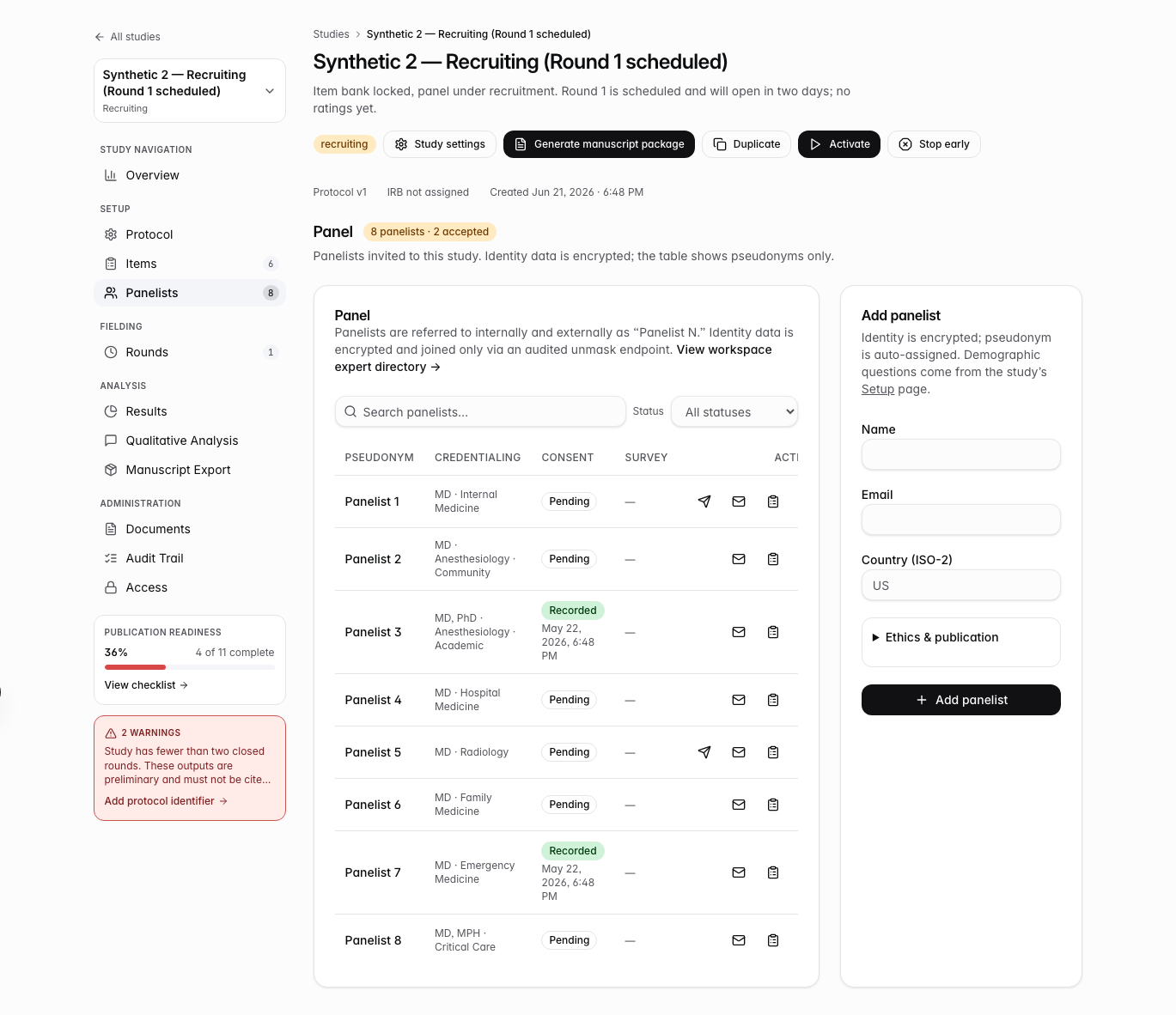
Pseudonymization
To protect panelist privacy, Delphi Studio uses strong pseudonymization:
| What researchers see | What is actually stored |
|---|---|
| Pseudonyms (Panelist 1, Panelist 2, …) | Encrypted name and email address |
| Expertise fields and credentials | As provided during enrollment |
| All ratings and comments | Linked only to the pseudonym |
Researchers work with pseudonyms in standard analytic and directory views. An authorized panel manager may reveal identity only through a deliberate action that requires an operational reason and commits an audit event before returning the identity. This design keeps identity access separate from routine review without preventing necessary panel operations.
Reusing eligible experts across studies
The organization-wide Expert directory is separate from the study panel. It indexes pseudonymous participation and shows a recruitment pool only for identity-linked experts who explicitly permit future contact.
Adding an eligible expert to a target study records the criteria snapshot, rationale, stakeholder role, and COI decision and creates a pending panelist. It does not send an email; sending and resending are separate commands. Historical participation alone never creates future-contact permission.
See Expert directory and recruitment for eligibility gates, directory decisions, candidate recruitment, and identity boundaries.
Invitation states
Each panelist moves through defined states during the study:
| State | Description | Available actions |
|---|---|---|
| pending | Panelist has been added but not yet invited | Send invitation |
| invited | Invitation has been sent | Resend invitation |
| accepted | Panelist has consented and is active | Include in upcoming rounds |
| completed | Reserved for panelists who finish all required rounds; not currently set automatically | — |
| withdrawn | Panelist has withdrawn — including by declining the consent form | Excluded from future rounds; withdrawal is audited and not reversible as “active” participation |
| unavailable | Researcher-marked incapacity or unreachability (not disengagement) | Reminders stop; excluded from prospective round denominators; prior-round data stays valid; state is reversible back to accepted, with audit |
| declined | Reserved; a panelist who declines consent is recorded as withdrawn, not declined | — |
| non_responder | Reserved for attrition flagging; not currently set automatically | — |
completed, declined, and non_responder exist in the data model but are not currently set by the platform. In practice, a panelist who declines the consent form (or a re-acknowledgment) moves to withdrawn.
Unavailable vs withdrawn
Use unavailable when a panelist becomes unreachable or incapacitated but their earlier ratings should remain valid for analysis. Use withdrawal when the panelist (or you) permanently ends participation. Both suppress reminders; only unavailable is designed to be reversed if the panelist returns. Marking unavailable requires a reason and is recorded in the audit trail.
These states help researchers track engagement, report attrition causes honestly, and manage follow-up efficiently.
Stakeholder roles and panel balance
When your study defines stakeholder groups (for example patients, clinicians, and methodologists), each panelist carries:
| Field | Role |
|---|---|
| Primary stakeholder role | Analytic stratum used for subgroup breakdowns and optional cross-stakeholder consensus rules. Dual-role experts are never double-counted. |
| Secondary affiliations | Descriptive only — useful for reporting panel composition |
The Panel view compares enrolled counts against recruitment targets set in the wizard and surfaces balance warnings when groups are missing, a single group dominates, or panelists lack an assigned primary role.
Consent & re-consent
Consent is tightly linked to the study protocol. When a panelist consents, their consent is bound to a specific protocol hash.
If the protocol is later amended:
- Delphi Studio generates a new protocol hash and records the amendment.
- Affected panelists receive a re-acknowledgment request tied to the new hash.
- What happens next depends on the study's re-consent mode (configured on Consent & comms):
- re_consent_required — opening a new round is blocked study-wide until every outstanding re-acknowledgment is resolved.
- notify_only — panelists are notified of the amendment, but nothing is blocked.
Declining a re-acknowledgment withdraws the panelist from the study.
All consent events are recorded in the audit log:
| Event | Audit record |
|---|---|
| Initial consent | panelist.consent |
| Protocol amendment applied | protocol.amendment_applied |
| Re-acknowledgment accepted | panelist.reack_acknowledged |
| Re-acknowledgment declined | panelist.reack_declined (followed by panelist.withdraw) |
This mechanism ensures that panelists are always consenting to the current version of the study.
Withdrawals, unavailability & suppression
Panelists may withdraw from the study at any time: by choosing Decline on the consent screen, via the withdrawal link in every study email footer, or by replying to a study email (handled by the inbound-email webhook). The withdrawal is immediately recorded, and the panelist is excluded from all future rounds. Researchers can also mark a panelist unavailable (with a reason) when incapacity—not voluntary withdrawal—is the issue.
Email suppression is handled automatically and operates at two scopes: hard bounces and spam complaints suppress the address platform-wide, while unsubscribes suppress it for that study only. Withdrawing in-app does not create a suppression entry — the withdrawn state itself stops study emails. Suppressed addresses will not receive further study emails, protecting both panelists and sending reputation.
If a late withdrawal or data correction changes who should count in a closed round, use derived re-analysis rather than rewriting frozen dispositions.
Monitoring participation
The panel dashboard provides real-time visibility into engagement:
| Surface | What it shows |
|---|---|
| Round progress | Per-round response tracking, so you can spot panelists at risk of dropping out |
| Panel balance | Enrolled counts per stakeholder role against recruitment targets, with imbalance warnings |
| Re-acknowledgment banner | Outstanding consent re-acknowledgments after a protocol amendment |
Invitation reminders are scheduled automatically at 3, 7, and 10 days after the invitation (configurable per study), so unaccepted invitations are followed up without manual work.
A dedicated Tasks page aggregates action items for the research team. Six issue types can appear: missing IRB number on an advanced draft, pending consent re-acknowledgments, a closed round awaiting a stopping decision, a round held past its close date, low response rate on a closing round, and a round closing soon.
Panel size guidance
Recommended panel sizes vary by study type:
| Study type | Typical panel size | Notes |
|---|---|---|
| Modified e-Delphi | 10–30 experts | Most common range for health services research |
| RAND/UCLA (by specialty) | 9–12 per group | Smaller, highly specialized panels |
| Pilot studies | 5–8 | Should be documented as a limitation |
Delphi Studio blocks activation when the enrolled panel is below the minimum panel size set during study design. Stakeholder-role imbalance produces a warning but does not block.
Email communications
Delphi Studio seeds one editable template per email kind for each study:
| Email kind | Trigger |
|---|---|
| Invitation | Initial recruitment |
| Invitation reminder | Follow-up when the invite has not been accepted |
| Reminder | Non-responder follow-up during an open round |
| Round open | A new round becomes available |
| Round closing | Reminder before a round closes |
| Round complete | Notification that a round has closed |
| Study complete | Study has concluded |
| Withdrawal confirmation | Confirmation when a panelist withdraws |
| Re-consent | Required when the protocol changes |
All email templates are editable on the Consent & comms screen in the study wizard. Quiet hours can be configured to delay sends during a nightly window. The window is applied in the panelist's timezone when one is on record and in UTC otherwise; the platform does not currently collect panelist timezones, so in practice quiet hours are evaluated in UTC.
Additional panel tools
- Per-panelist link copying — copy a panelist's secure access link directly from the panel list.
- Candidate recruitment from the expert directory — pull candidates from your organization's expert directory, with conflict-of-interest status captured at selection.
- Panelist detail page — per-panelist round progress, outlier flags, audit history, and stakeholder-role reassignment.
- Ethics & publication intake — acknowledgment preference (named, anonymous, or none) and related publication details captured when adding a panelist.
- Idempotent email sends — scheduled sends carry idempotency keys, so retries never double-send.
- Audited identity unmasking — revealing a panelist's real identity records a
panelist.unmaskaudit event.
Next steps
- Panelist experience — what panelists see after they click the magic link
- Expert directory and recruitment — consent-aware reuse across studies
- Running rounds — open, close, and iterate
- Collaboration & roles — who on the research team can manage the panel
- Audit trail — consent and invitation events in the log