Running rounds
Rounds are the operational core of any Delphi study. They represent the structured, iterative cycles through which expert judgment is collected, refined, and synthesized toward consensus. Delphi Studio provides clear workflows for creating, scheduling, opening, closing, and iterating rounds while maintaining methodological rigor and full auditability.
Round lifecycle
Every round progresses through five defined states:
| State | Description | Researcher actions |
|---|---|---|
| draft | Round is being prepared | Define timing, confirm items, set windows |
| scheduled | Round is configured and will open automatically at the scheduled time | Monitor countdown; can still edit before opening |
| open | Panelists can submit ratings and comments | Monitor response rates in real time |
| closed | No new ratings accepted | Trigger analysis or review results |
| analyzed | Statistics, classifications, and dispositions have been computed | Review results, prepare feedback, plan next round |
This lifecycle ensures that every round follows a consistent, documented process from preparation through analysis.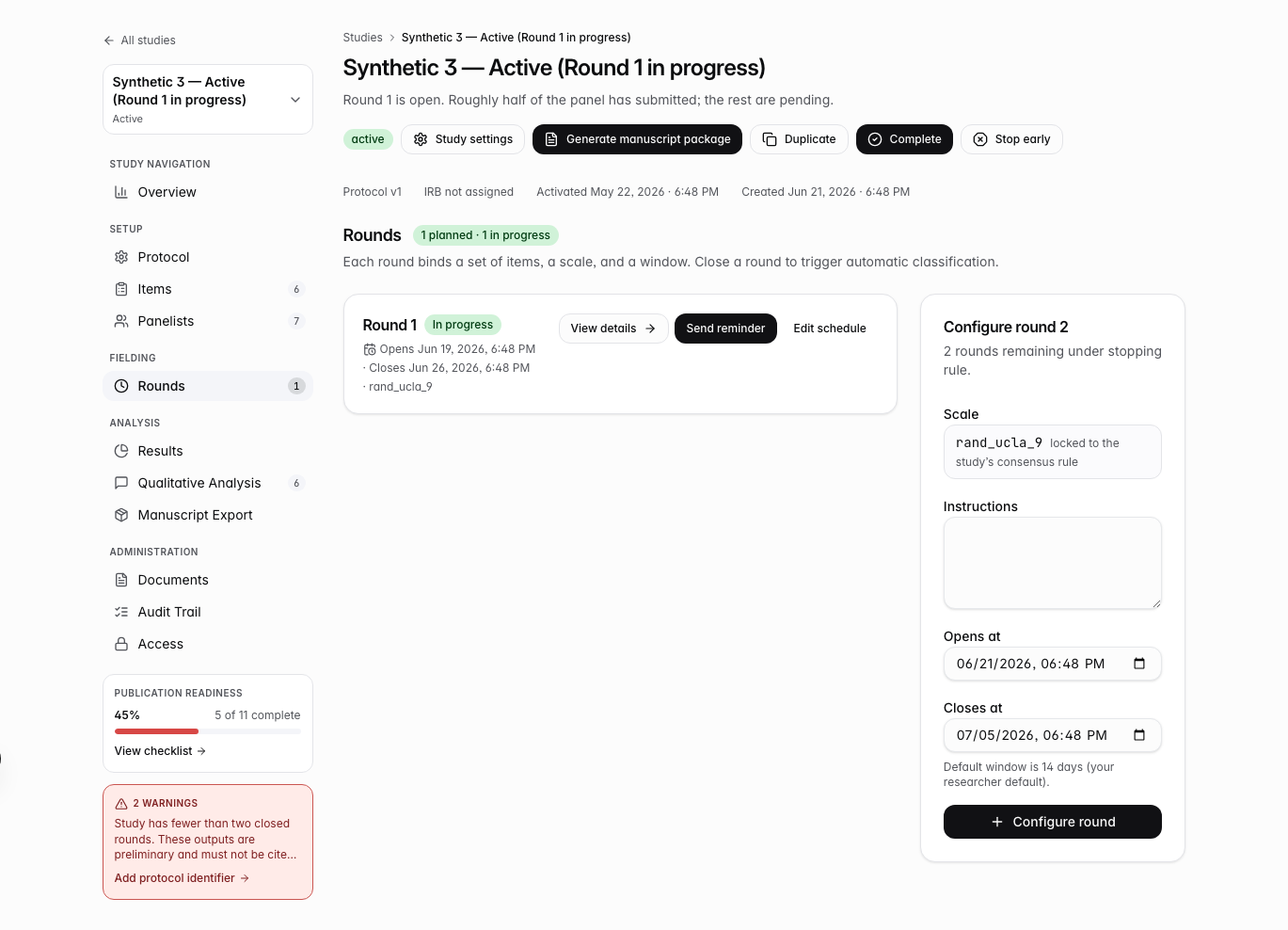
Creating Round 1
After panel recruitment and consent are complete, you can create the first round:
- Go to Rounds → Create round (or use the round automatically created from your wizard defaults).
- Confirm that the correct active items from the item bank are included.
- Set the
opensAtandclosesAtdates to define the rating window (for example, a 10-day period). - Open the round manually, or let the scheduler open it at
opensAt. When the scheduler opens a round, it sendsround_openemails to eligible panelists, respecting configured quiet hours; opening a round manually does not send emails. On both paths, panelists with a pending re-consent requirement are held back until they re-acknowledge.
Once opened, panelists can begin rating immediately.
Planning subsequent rounds (Round 2+)
Before opening Round 2 or later, use the Plan next round feature. It becomes available only after every disposition from the previous round has been confirmed. The tool automatically selects items based on their disposition from the previous round:
| Disposition | Default inclusion in next round | Notes |
|---|---|---|
| re_rate | Included | Items that need another round of rating |
| revise | Included (with revised wording) | Researcher has updated the item |
| Indeterminate | Included | Items that did not yet reach consensus |
| retain | Excluded | Consensus achieved |
| drop | Excluded | Item removed from the study |
You can manually override the default inclusion for any item. Excluding an item that would otherwise carry forward requires a rationale, and the complete plan is recorded in the audit log before the next round's items are created.
Panelist-proposed statements
When the method allows new item suggestions, panelists may propose statements during a round. Proposals are de-identified and appear in Plan next round for researcher adjudication:
| Outcome | Effect |
|---|---|
| Approved | Creates a rateable item with panel provenance retained |
| Rejected | Kept as a rejected suggestion for audit; not added to the item bank |
Approved proposals can be scheduled into the next round like any other active item.
Feedback packet lock (Round 2+)
For studies using controlled feedback, you can require that feedback packets be locked before opening Round 2 or later. Pre-open locking is opt-in, controlled by the feedback lock required setting (feedbackLockRequired).
| Step | Purpose |
|---|---|
| Preview | Review medians, histograms, zone distributions, and approved de-identified comments |
| Lock (optional) | Create an immutable snapshot of the feedback for each panelist before the round opens |
| Open round | Panelists see feedback immediately upon entering the round |
How freezing works: When the pre-open lock is required, the system blocks round opening until packets are locked, so every panelist receives exactly the same information from the start. When it is not required, each panelist's feedback packet is frozen the first time they view it — it cannot change for them afterward — but panelists who first view at different times may see feedback generated at different moments. Requiring the pre-open lock removes that possibility.
Here is the typical sequence:
Deadlines, grace windows, and extensions
Round timing is configured in the wizard and refined when you create or open each round.
| Capability | What it does | Why it matters |
|---|---|---|
| Timezone preview | Before you commit a deadline, preview what that instant means in every panelist's local timezone | Fairness for international panels |
| Grace window | Optional prespecified minutes after closesAt (up to 24 hours) during which late submissions are still accepted and labeled as in-grace; the close sweep waits out the window | Avoids “cron lottery” acceptance of late ratings |
| Deadline extension | Extend an open round’s closesAt with an audited change and fair notice to the panel | Clinical schedules slip; extensions keep the process defensible |
Grace minutes apply only when accept-late / grace is enabled for the study, and are capped at 24 hours — for anything longer, use an audited deadline extension instead. Extensions never rewrite ratings already submitted; they only move the close boundary forward.
Automated operations
Delphi Studio's background worker automates several round-related tasks on a schedule:
| Job | What happens | Researcher control |
|---|---|---|
| Round open | Moves scheduled round to open at opensAt | Can also open manually |
| Round close | Moves open round to closed after closesAt (plus any grace window) | Can also close manually |
| Analytics | Runs consensus engine after round closes | Automatic, but results are reviewed by researcher |
| Reminders | Sends pre-close nudges to non-responders | Configurable cadence and quiet hours |
Researchers retain the ability to manually open or close rounds when needed.
Response-rate floors
On the Analysis & reporting screen, you can set a minimum response rate threshold for each round. If a round reaches its close time below this floor:
- The round is held open — closing is blocked — until you acknowledge the low response with a documented rationale.
- An attrition caveat is added to reports and the stopping recommendation.
Example:
| Round | Responses | Floor | Action |
|---|---|---|---|
| 1 | 12 / 15 (80%) | 70% | Close normally |
| 2 | 8 / 15 (53%) | 70% | Round held open until low response is acknowledged |
This feature helps maintain transparency about participation levels.
Stopping recommendations
After each round is analyzed, Delphi Studio provides a stopping recommendation based on the current state of the study:
| Recommendation | Typical recommended action |
|---|---|
| consensus_reached | Move to final reporting and mark the study complete |
| tentative_consensus_low_response | Treat consensus as provisional; document response-rate caveats |
| stable_contested | Review remaining indeterminate items; consider accepting limitations or adjudicating |
| still_moving | Plan another round of rating |
| max_rounds_reached | Conclude the study and report with caveats on unresolved items |
| insufficient_history | Not enough round history for a stability-based stop |
These recommendations are advisory. Researchers can make their own determination while documenting their reasoning.
Item revision between rounds
When items remain indeterminate or require improvement, you can revise them between rounds:
- Review indeterminate items on the Results dashboard.
- Edit the item wording in the item bank (this creates a new version linked to the original).
- Optionally run qualitative analysis on panelist comments to inform the revision.
- Use Plan next round to include the revised items in the upcoming round.
All item revisions are tracked with full version history for transparency and auditability.
Round monitoring
While a round is open, you can monitor progress through several views:
| View | Information provided |
|---|---|
| Round detail | Completion progress, number of comments received |
| Dashboard | Overall study-level participation metrics |
| Tasks | Pending actions such as reminders or blockers |
These views help you stay informed and take timely action (such as sending reminders) without disrupting the panelists' experience.
Next steps
- Consensus analytics — how statistics are computed
- Interpreting results — heatmaps, overrides, re-analysis, stopping
- Panelist experience — feedback and proposals from the panelist side
- Multi-round worked example — end-to-end scenario