Study design wizard
The Study Design Wizard is Delphi Studio's guided, 11-screen process for creating a new study. It is located at /studies/[id]/setup and walks researchers through every methodological decision in a logical sequence.
The wizard ensures that critical elements — such as consensus rules, panel criteria, and governance settings — are defined before any panelist is invited. This prevents mid-study changes that could compromise the validity or interpretability of results. Each screen focuses on a distinct part of the study design, with no duplication across steps.
Wizard structure
The 11 screens are logically grouped into three phases:
- Foundation — Screens 1–4: Establish the study's identity, purpose, overall approach, and core method.
- Content — Screens 5–8: Define the panel rules, items, rating scales, and feedback process.
- Governance & Launch — Screens 9–11: Address ethics, communication, analysis plans, and final validation before launch.
This structure helps researchers build a complete, coherent protocol systematically.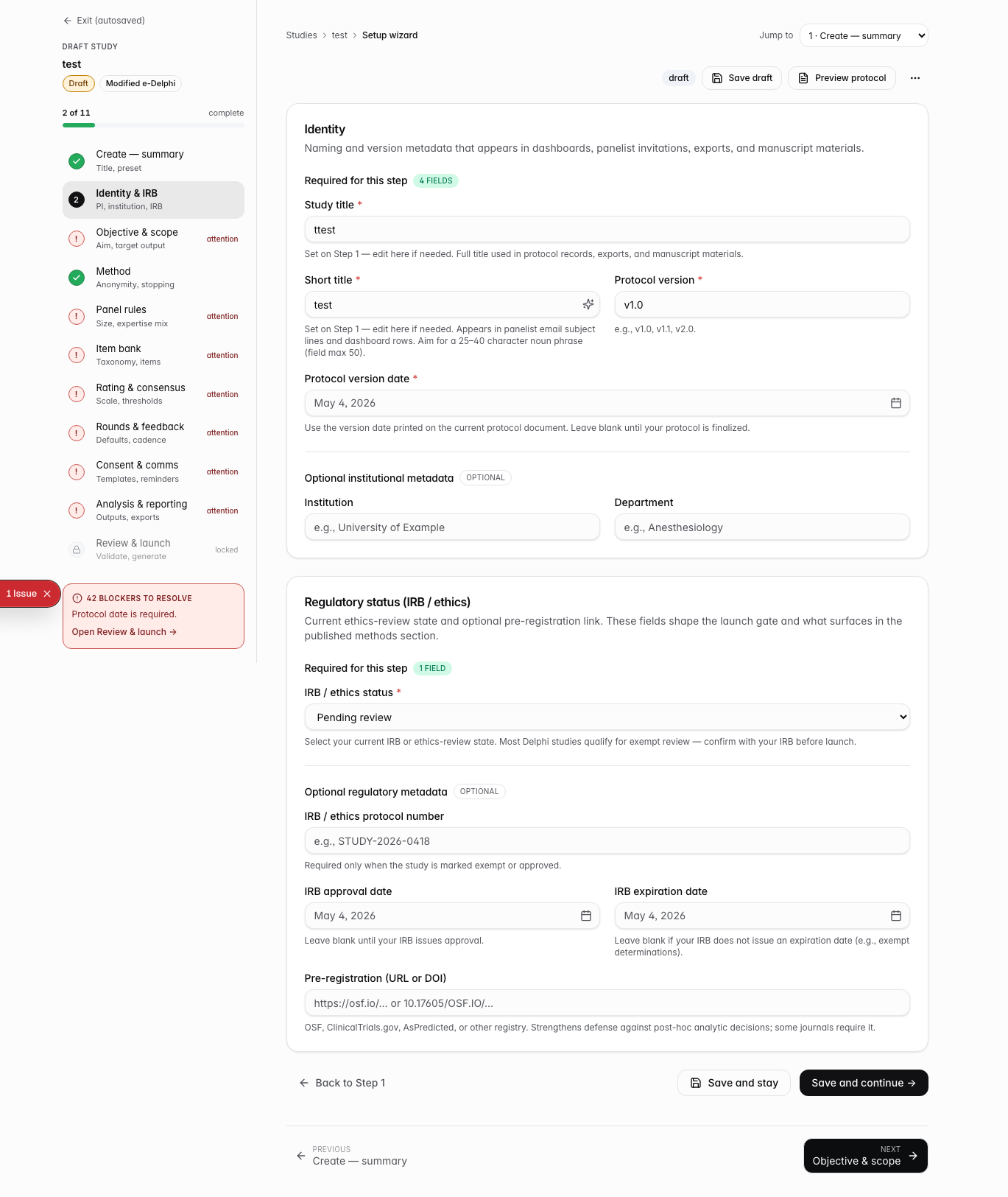
Screen reference
| # | Screen | What you configure | Why it matters |
|---|---|---|---|
| 1 | Create | Study title, method preset (Modified e-Delphi, RAND/UCLA Appropriateness, or Custom), option to duplicate an existing study | Sets the foundation and applies sensible defaults based on your chosen approach. |
| 2 | Identity & IRB | Principal investigator, institution, IRB number, protocol version | Establishes accountability and regulatory documentation from the start. |
| 3 | Objective & scope | Research aim, consensus question, target audience, and scope of the study | Clarifies what the panel is being asked to achieve. |
| 4 | Method | Delphi type, level of anonymity, number of rounds, stopping rules, comment requirements | Defines the core rules that will govern how consensus is reached. |
| 5 | Panel rules | Target panel size, eligibility, expertise domains, stakeholder mix targets | Ensures the panel has the right composition and expertise to answer the research question. |
| 6 | Item bank | Taxonomy, items, CSV import, source citations, statement quality review | Builds the content that panelists will evaluate. |
| 7 | Rating & consensus | Scale, dimensions, thresholds, bimodality, optional cross-stakeholder rules | Establishes the statistical rules used to classify items after each round. |
| 8 | Rounds & feedback | Timing, grace window, feedback content, comment approval mode, reminders | Controls how iteration and controlled feedback will occur. |
| 9 | Consent & comms | Consent language, email templates, quiet hours for reminders | Supports ethical practice and respectful communication with panelists. |
| 10 | Analysis & reporting | Minimum response requirements, subgroup analysis settings, export preferences | Prepares the study for high-quality analysis and reporting. |
| 11 | Review & launch | Final validation checklist, acknowledgments, and study activation | Serves as the final checkpoint before the methodology is locked. |
Method presets (Screen 1)
On the first screen, you can choose a method preset. These presets automatically configure many later screens with recommended settings based on established Delphi approaches.
| Preset | What it seeds | Best used for |
|---|---|---|
| Modified e-Delphi | 5-point Likert scale, primary Agreement dimension, consensus rule of ≥80% in agree zone + median ≥ 4 + IQR ≤ 1 | Most health services research, competency frameworks, and guideline development |
| RAND/UCLA Appropriateness | 9-point appropriateness scale and Disagreement Index (DI) threshold | Clinical appropriateness studies |
| Custom | Same defaults as Modified e-Delphi, but every section requires explicit confirmation so you can fully customize | Studies with unique methodological requirements |
You can change any seeded values later in the wizard. The Custom option is useful when your study does not fit neatly into standard approaches. See Comparing Delphi types.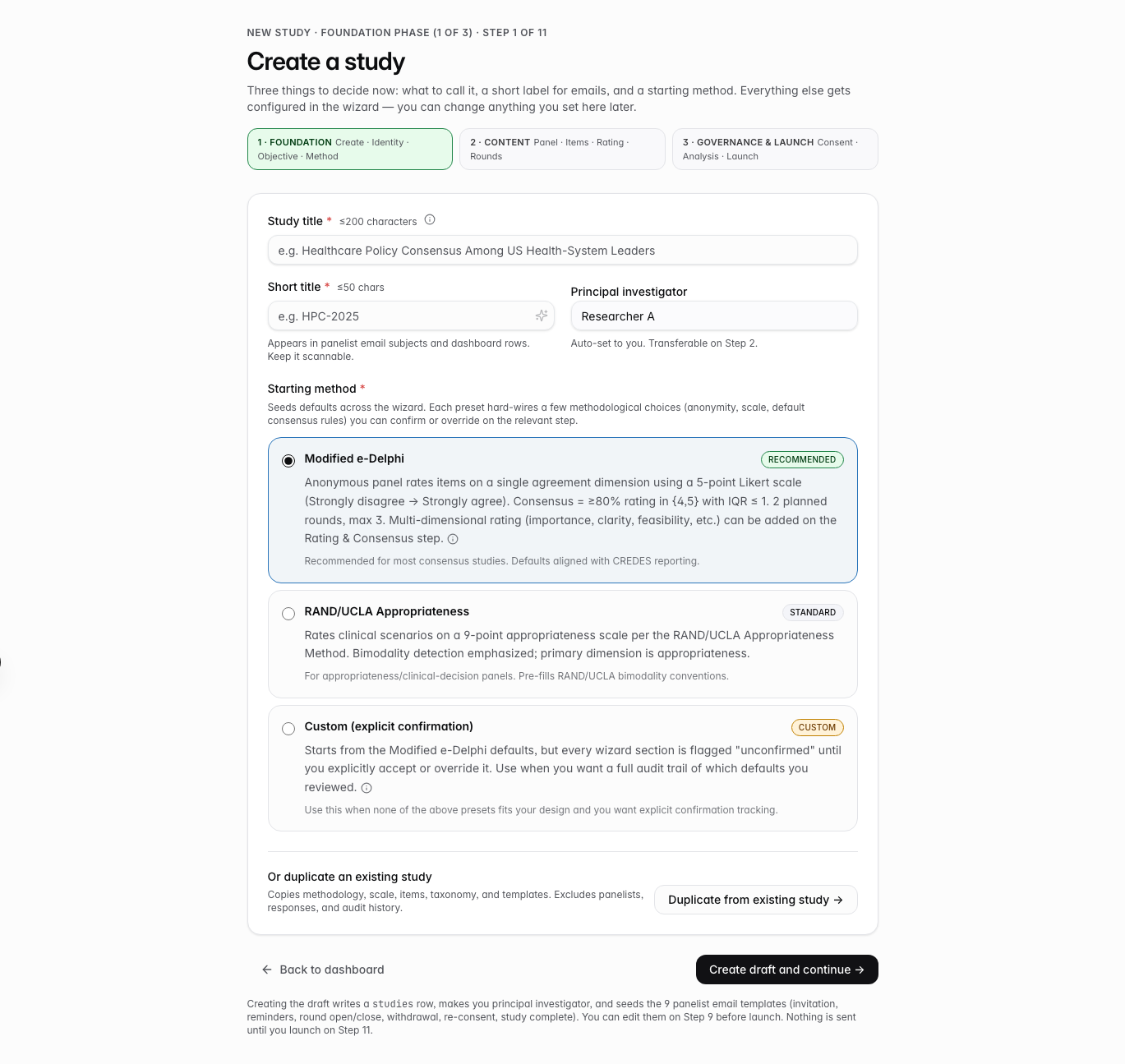
Item bank (Screen 6)
The item bank is where you define what the panel will evaluate. Delphi Studio supports structured item management with the following features:
- Taxonomy — Organize items into domains and types using stable identifiers. This helps with analysis and reporting.
- CSV import — Bulk upload items with validation to catch formatting issues early.
- Typed source citations — Attach literature, guideline, interview, or prior-study sources (optional URLs) so every statement traces to evidence; lineage survives revisions and appears on results pages and DOCX statement tables.
- Statement quality review — On-demand advisory pass over the item bank flags multi-barreled statements (with suggested splits), technical reading level, ambiguous terms, and near-duplicate overlap before launch. It is run from the Items workspace (
/studies/[id]/items) rather than from this wizard screen. Findings are drafts for the research team; deterministic overlap checks run without a model call. - Item states — Items move through draft → active → retired states.
- Versioning — When an item is revised between rounds, the new version is linked to its parent item, preserving full history.
- Organization templates — Reuse taxonomy structures and item sets from previous studies within your organization.
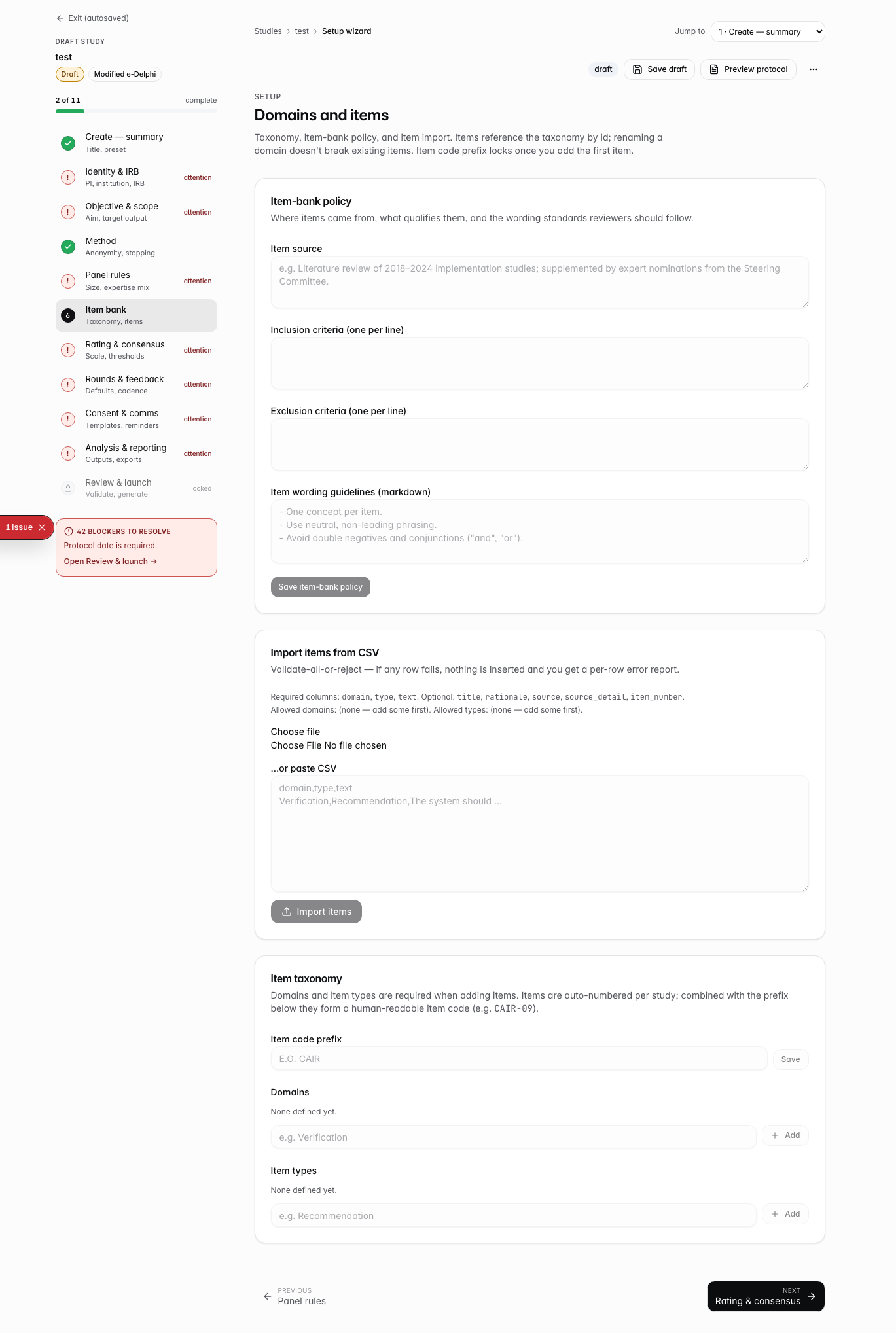
Example CSV columns for bulk import:
| column | example |
|---|---|
| domain | Clinical practice |
| type | Competency |
| text | The nurse should document telehealth consent before each visit. |
Rating & consensus (Screen 7)
This screen is where you define the statistical contract for your study — the rules that will determine whether an item reaches consensus.
Key settings include:
- Primary dimension (e.g., Agreement)
- Thresholds for the Agree zone (e.g., ≥80% of ratings in the top two scale points)
- Minimum median value required for agreement
- Maximum allowable IQR (dispersion)
- Bimodality detection (to flag polarized items)
- Optional cross-stakeholder consensus conditions — panel-wide agreement can be downgraded when a prespecified stakeholder group of sufficient size shows substantial opposition (see Consensus analytics)
These rules are important because they are snapshotted per round when the round closes. Any changes made after Round 1 begins are recorded in the audit log with before-and-after values, protecting the integrity of the study. See Consensus analytics and Modified e-Delphi.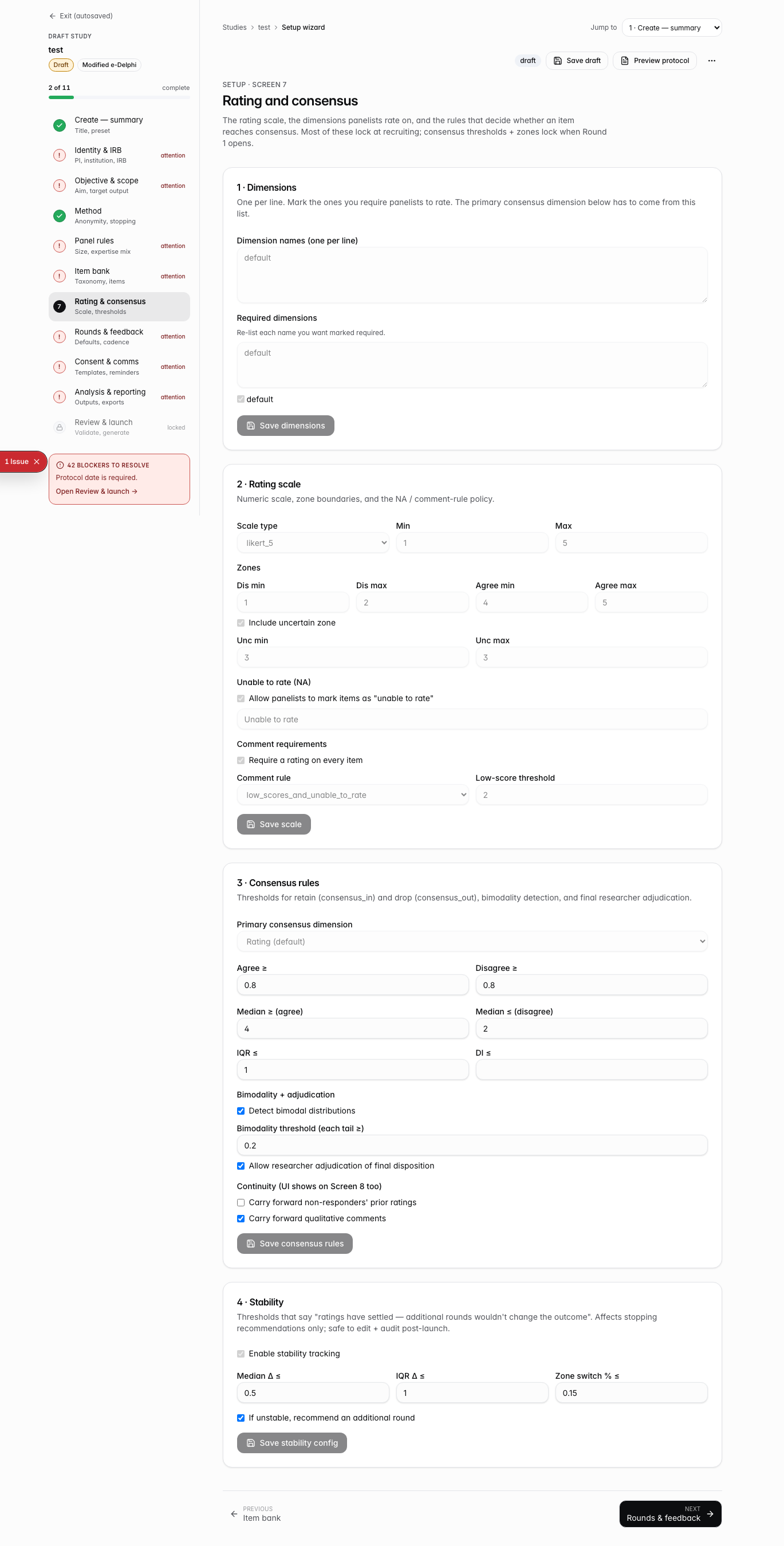
Rounds & feedback (Screen 8)
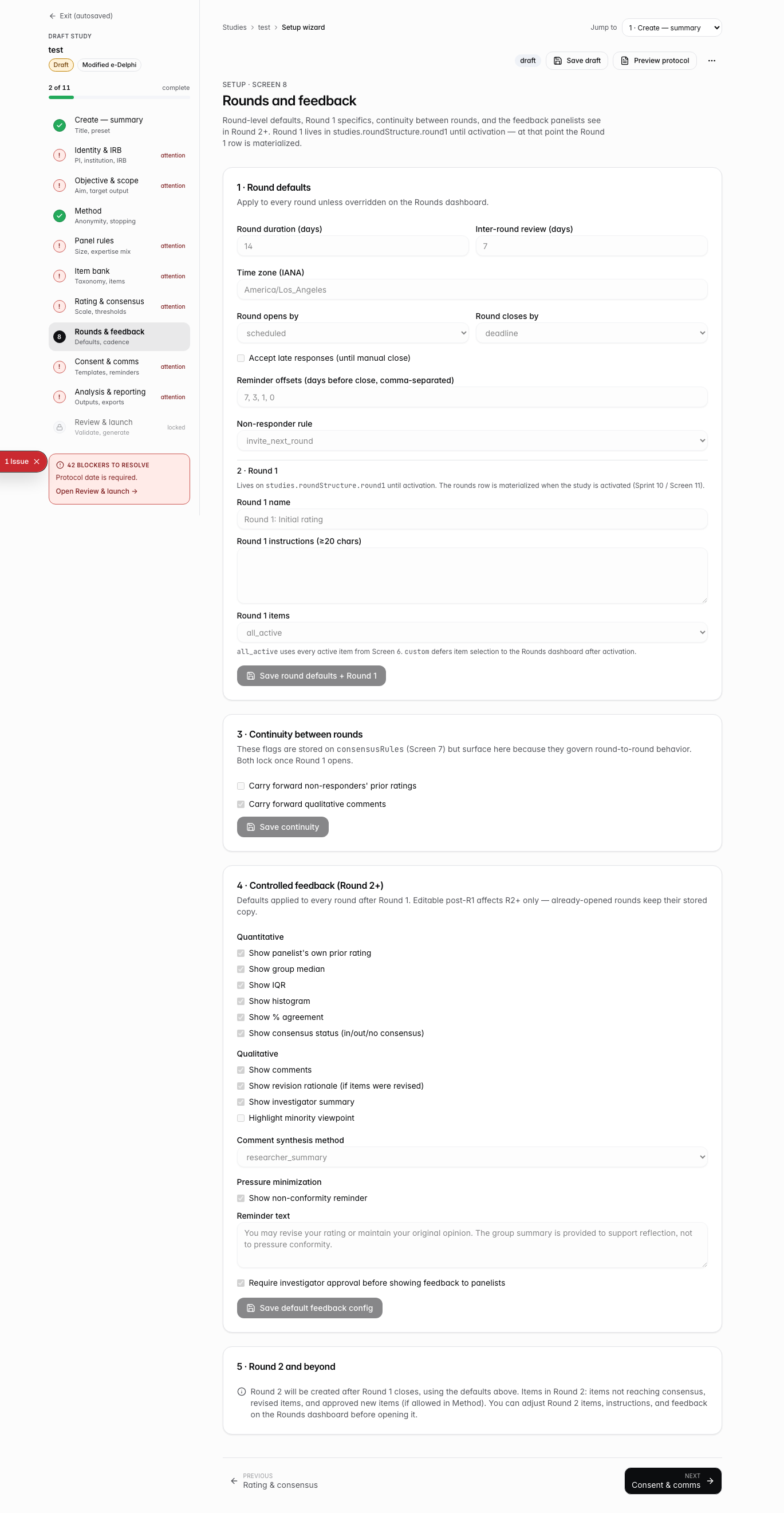
This screen sets round timing defaults, Round 1 structure, continuity between rounds, and the controlled feedback panelists see from Round 2 onward.
Notable options:
| Option | Purpose |
|---|---|
| Round duration and reminder cadence | Operational windows for rating |
| Accept late responses / grace minutes | Prespecified late window after closesAt (submissions labeled in-grace) |
| Quantitative feedback | Medians, histograms, zone bars, own prior rating |
| Qualitative feedback | Approved de-identified comments |
| Comment approval mode | review_all (default for new studies) or auto_when_clean after redaction |
| New item suggestions | Whether panelists may propose statements during rounds |
Launch validation (Screen 11)
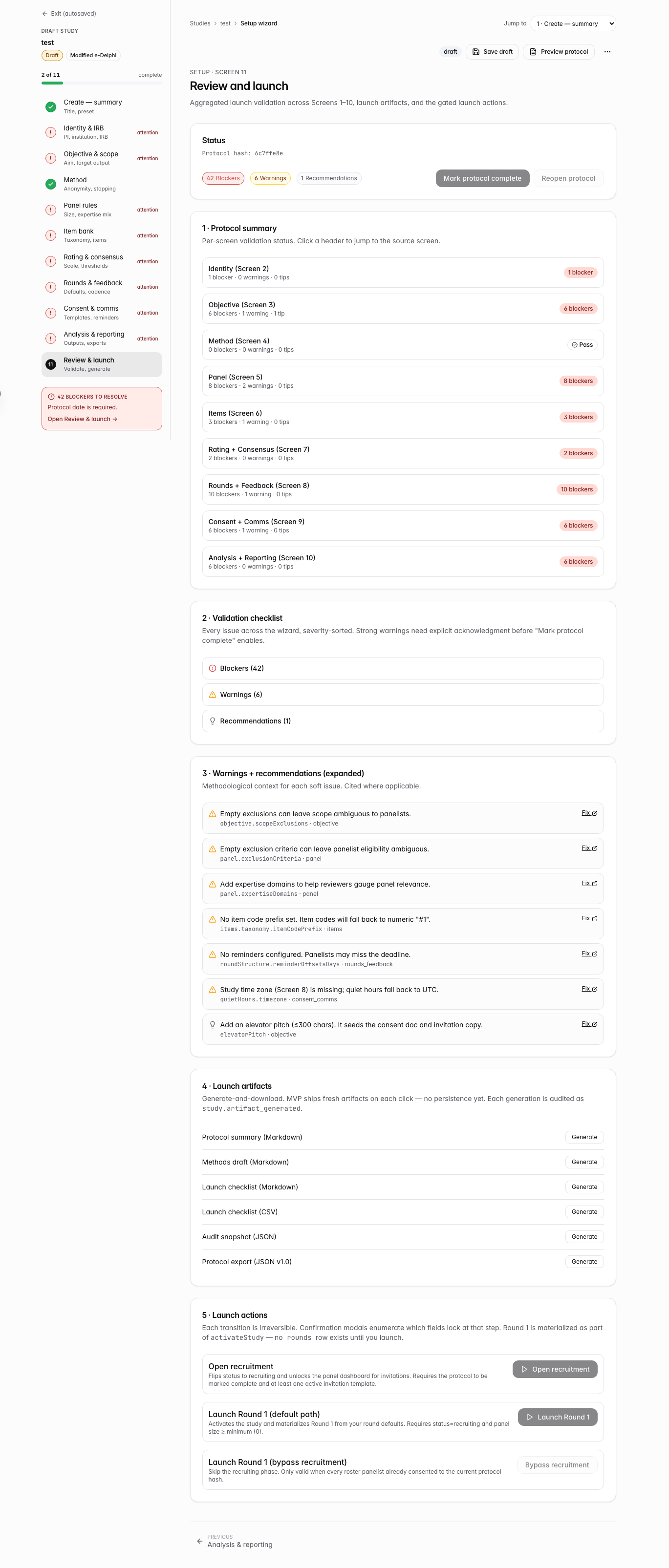
Before a study can be activated, Delphi Studio runs a series of validation checks across all previous screens. These checks are divided into two categories:
| Severity | Behavior |
|---|---|
| Blocker | Must be fixed before the study can be activated |
| Strong warning | Must be acknowledged before launch. The acknowledgment records the click together with a fingerprint of the current configuration value; if that value later changes, the acknowledgment goes stale and must be renewed |
| Warning | Shown for review; does not block activation |
Common blockers include:
- No active items in the item bank
- Missing consent text
- Consensus thresholds that have not been set
- Missing IRB details for the study's IRB status — an IRB number is required when the status is exempt or approved, and an approval date is also required when approved
Activation sequence
When you complete the final screen, the following sequence occurs:
- markProtocolComplete — Confirms that the methodology is finalized.
- openRecruitment — Opens the study for panelist invitations. This step can be bypassed only when every panelist on the roster has already consented to the current protocol version (
protocolHash); the bypass requires an acknowledgment plus a written rationale of at least 20 characters. - activateStudy — Activates the study and captures the launch snapshot, which freezes the methodology for the remainder of the study. Activation also materializes Round 1, freezes the feedback configuration, and generates the reminder schedules.
See Delphi Platform for how Design fits into the full study lifecycle.
Field locking after launch
Once a study is activated, not all fields remain freely editable. Delphi Studio applies different policies depending on the field:
| Policy | Meaning |
|---|---|
| editable | The field can be changed freely |
| audit | Changes are allowed but are logged with before-and-after values |
| locked | The field is disabled in the interface and cannot be changed |
Locking begins as early as the recruiting status: the Delphi type and anonymity level cannot change once recruitment opens. Items and consensus rules typically move to audit or locked status once Round 1 opens. The maximum number of rounds stays under the audit policy after launch and can only be increased, never decreased. This protects the interpretability of the data already collected.
Templates
Delphi Studio supports two forms of reuse:
| Type | When it is used | Purpose |
|---|---|---|
| Method presets | Screen 1 only | System-level defaults for Modified e-Delphi, RAND/UCLA Appropriateness, or Custom |
| Study templates | Setup landing page and the Panel rules screen | Org-scoped templates carrying taxonomy structures, item-bank policy, and study configuration (scale, consensus rules, panel rules, analysis defaults) to standardize a research program — never item statements |
Templates are managed at /templates and are scoped to your organization. To reuse item statements from a previous study, duplicate that study instead (the duplicate option on Screen 1); templates intentionally exclude statement text.
Next steps
- Panel management — recruit and manage experts
- Running rounds — open, close, and iterate
- Collaboration & roles — who can edit the wizard after launch
- Clinical guideline example — end-to-end scenario